Nearly two months after Israeli and US strikes killed Iran’s Supreme Leader and drew Tehran into retaliation across the Gulf, the region has settled into an uneasy quiet. This is not peace. It is a fragile equilibrium, a balance sustained less by diplomacy than by other factors. Neither Washington nor Tehran wishes to escalate the war, despite the various rhetoric from both sides. Yet the conditions that produced the last confrontation remain intact.
Understanding this moment requires holding three dimensions together: the mutual deterrence that has set in between Iran and the US; the wider regional balance in which Israel, the Gulf monarchies, Turkey, Russia and China operate; and Iran’s internal endurance, the capacity of the Iranian state to absorb shocks that were once expected to break it.
The Escalation of the war and consequances
For Washington, the first reason for restraint is economic factors and the internal political pressure that Donald Trump faces, particularly from his core supporters. A full escalation would fall on an already fragile world economy, and the pressure point is the Strait of Hormuz. In 2024, roughly twenty million barrels of oil and petroleum products a day — about 20 per cent of global consumption — moved through the Strait, alongside close to one-fifth of the world’s LNG trade in 2025; some 93 per cent of Qatar’s LNG exports and 96 per cent of the UAE’s travelled the same route, with no practical alternative. A serious interdiction would not simply raise petrol prices; UNCTAD has warned that disruption through Hormuz raises energy, fertiliser and transport costs at once, and the World Bank’s early-2026 update showed urea up close to 46 per cent month-on-month. The IMF’s assessment is consistent: such disruptions point to higher prices and slower growth, with import-dependent countries in the Global South bearing the heaviest burden. Iran’s capacity to threaten Hormuz is the economic core of its asymmetric posture, and what keeps Washington cautious.
The strategic lesson has been as unambiguous as the economic one. A quarter-century of American wars, in Afghanistan, Iraq, Libya, and Syria, has already demonstrated that bombing campaigns can dismantle infrastructure but rarely construct legitimacy. Iran was not decapitated by the strike. Power remained distributed across the clerical councils, Revolutionary Guard command structures, intelligence networks, and state-linked economic conglomerates that constitute the Islamic Republic’s real architecture. What the US achieved was escalation without resolution, and a deepened exposure of its Gulf allies, Saudi Arabia, Bahrain, Qatar, Oman, Kuwait, and the United Arab Emirates, whose host bases became targets in Iran’s asymmetric response. Moreover, Iran showcased its missile capabilities, demonstrating that they can strike US bases in the region and, in some instances, potentially destroy those intended to provide security for the Gulf countries.
The calculus in Washington has therefore shifted. Further escalation risks a regional war in which US installations, Gulf monarchies, energy markets, and the financial networks that tie sections of the American political class to the Gulf are exposed at once. For Tehran, any new confrontation would be waged from a weaker position: its deterrent partly depleted, its economy further strained, its population restless. Restraint, in this sense, is not a strategic choice but a product of mutual overstretch. Both sides have learned that they cannot end the other cheaply, and neither is willing to pay what a decisive outcome would cost.
The war aims
The restraint that has followed should not obscure what each side was reaching for when the strikes began. Israel’s aims have been more clearly articulated. For more than a decade, and especially under Netanyahu’s present coalition, Israeli strategy has pursued a vision of a Middle East in which Israeli power is not contested. Some ministers in the current government speak openly of a “Greater Israel” whose borders are deliberately left undefined but whose dominant position is meant to be unmistakable. The aim is not only security; it is the consolidation of Israel as the region’s only advanced industrial and technological power. Threats have been issued not only against Iran but, in recent statements, against Turkey itself. The decision to strike Iran reflected a calculation, encouraged by Netanyahu and apparently received in Washington, that the Islamic Republic could be quickly overthrown after a short and decisive attack. That calculation has turned out to be wrong.
Embedded in this strategy is a longer-term aim that has surfaced repeatedly in Israeli policy circles: the fragmentation of Iran as a unified state. An Iran broken into competing regions or ethnic enclaves would, on this reading, give Israel decisive leverage and remove the most significant remaining state-level challenger to its hierarchy. Whether such fragmentation is achievable is a different question. The most likely consequence would be prolonged internal conflict and the spillover of instability into Turkey, Pakistan, Afghanistan, and the Gulf, outcomes that no neighbour desires, and that would expose the limits of any external actor’s ability to manage the region.
Washington’s aims are harder to read with the same clarity, because several logics intersect. The first is global: the US seeks to discipline opposition wherever it emerges and to reaffirm itself as the dominant power in a system whose unipolar moment has clearly passed. The second is economic and structural, weakening China’s access to cheap energy and to the regional corridors on which its long-term integration into West Asia depends. Iran’s geography is central to that calculation. The third is political and historical: the 1979 revolution remains, for sections of both parties in Washington, an unhealed grievance and a standing affront. The Islamic Republic is not, in any serious sense, an anti-imperialist state, but it has continued to disrupt Western dominance in ways that are no longer tolerated, particularly as competition with China has intensified. The administration’s broader objective is to reaffirm the US as the indispensable global power, even as the costs of that reaffirmation accumulate.
Whether US policy actively supports the fragmentation of Iran is more difficult to assess. American strategy under the present administration shifts rapidly, and the public record is unreliable. Some policymakers consider such scenarios; military and intelligence advisers tend to warn against them. The longer pattern is nonetheless suggestive. Since the 1970s, Washington has moved from a phase of “building” regional influence to one of destabilisation — Iraq, Syria, and Libya illustrate what follows when fragmentation becomes a tool rather than a risk. Yet fragmentation is rarely controllable. Despite the rhetoric, the maintenance of Iran’s territorial integrity may yet prove to serve US interests more reliably than its dismemberment.
A regional balance without a centre
Israel’s strategy has, for now, reached its limits. The war in Gaza has eroded much of the international legitimacy once available to justify the broader campaign, the prolonged confrontation with Hezbollah in Lebanon, repeated strikes on Syria, the engagement with the Houthis in Yemen, and now the assault on Iran. Israeli action against Iran drew condemnation rather than coalition; the Abraham Accords are visibly strained; a hardline domestic coalition has narrowed rather than widened the country’s strategic options. Israel retains overwhelming military superiority, but for the first time in a generation, it confronts the limits of what that superiority can deliver politically.
Gulf states, whose territories suddenly became battlegrounds, have rediscovered the dangers of serving as staging grounds for confrontations in which they have no direct interest. Saudi–Iranian channels, reopened through Chinese mediation before the war, have quietly been re-engaged. Into the diplomatic space left by Western retreat from negotiation, regional and non-Western actors have moved with growing confidence. Oman, Turkey and now Pakistan have emerged as central voices urging compromise. Pakistan, sharing a long border with Iran and conscious of its own nuclear status, has worked to reopen lines between Tehran and the Gulf and to insulate Iran from the worst diplomatic isolation. Turkey, at once a NATO member and an increasingly autonomous regional power, has used its energy ties with Iran and its standing across the Sunni world to press for a negotiated settlement, drawing on the precedent of the Astana process on Syria. Neither seeks to underwrite the Islamic Republic, and both have their own grievances with Tehran. But each has concluded that a wider war serves no one’s interests, and that the costs of inaction would fall first on their own economies and societies. Together with Chinese mediation, their interventions mark a clear shift: peace-making in this region, in this conjuncture, has moved decisively away from Washington.
Russia and China, for their part, have not rescued Iran decisively, but neither have they abandoned it: a fractured but intact Islamic Republic serves their interests better than either a collapsed state subject to Western reconstruction or a war whose energy shocks would destabilise global markets. This is the texture of the new disorder: issue-based alignments rather than coherent alliances, bilateral arrangements rather than treaty systems, a world in which no single power can impose an outcome and none are willing to accept one on another’s terms.
Endurance, not collapse
The most misunderstood element of the current balance lies within Iran itself. Four decades of sanctions, covert operations, and diplomatic exclusion were designed to produce collapse. They produced an adaptation instead. Informal economies have absorbed the shocks that formal institutions could not. Asymmetric military doctrine has made the cost of attacking Iran greater than the strategic benefit. Hybrid forms of governance, in which clerical authority, security networks, and semi-private conglomerates share power, have proved more resilient to external pressure than the formal institutions of a unitary state.
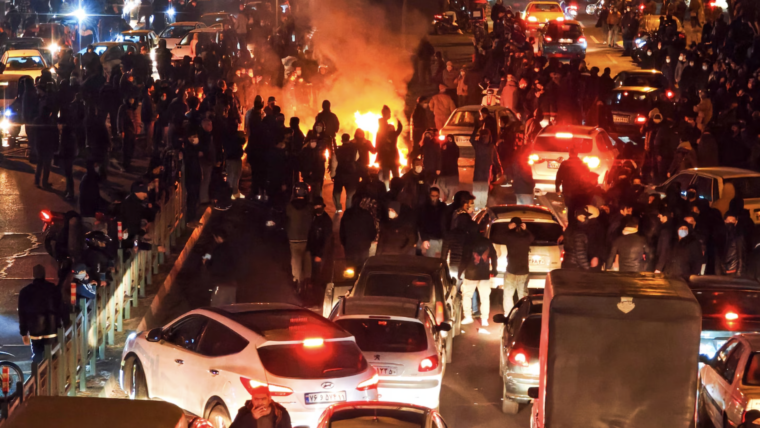
This is not a portrait of stability. Inflation remains above fifty per cent. The protest wave that broke across Iranian cities in January has not disappeared; it has been forced below the surface of public life, where it continues to erode the regime’s legitimacy. Political prisoners are among the most exposed, while the wider population lacks even basic protections from the consequences of war and economic disruption. The crisis of authority identified before the war has deepened rather than been resolved. The regime endures precisely because its adversaries mistook brittleness for fragility, and fragility for imminent failure. Endurance, however, is not the same as stability; it describes a society learning to live with prolonged crisis rather than one that has resolved it.
There is no doubt that the war imposed by the US and Israel, together with statements such as Donald Trump’s “A whole civilisation will die tonight” and Benjamin Netanyahu’s “The struggle against Iran pits civilisation against barbarism,” galvanised many Iranians around national unity against an outside threat. This did not redeem the Islamic Republic, but it did support its survival.
Difficult conditions test people in different ways. Many Iranians have responded to the war with solidarity, helping each other, donating blood, and supporting those displaced or bereaved. The sense of national unity is real because most people experience the strikes as attacks not on a government but on the country itself. War also exposes divisions and contradictions; however, the underlying questions, inequality, corruption, and the demand for justice do not disappear under bombardment. Encouraging public gatherings during sustained violence carries its own risks, given the scale of repression seen in recent years. The endurance now visible is therefore double-edged: it has reinforced the state’s survival while leaving intact the conditions that produced January’s protests.
Uncertain trajectories
Predicting where this conflict goes next remains extremely difficult. Multiple trajectories remain possible: prolonged confrontation, a diplomatic resolution, or some form of internal political shift, and much of what shapes each runs through closed-door negotiations, intelligence channels, and elite calculations that even close observers cannot fully see. What is far more visible is the human cost: the burden of any further escalation will fall, as it always does, disproportionately on ordinary Iranians, already marked by repression, hardship, and exclusion.
Equally visible is the absence of credible political alternatives. The figures most often presented to Western audiences as potential successors lack both legitimacy and meaningful organisation inside Iran; their prominence reflects geopolitical utility rather than social rootedness. The lesson of Iraq, Afghanistan, and Libya is not only that foreign-imposed regime change rarely yields a durable political order, but that it tends to strengthen the very security structures it claims to dismantle. Real transformation cannot be imposed from above or from outside; it must emerge through processes shaped by Iranian society itself.
Behind these immediate questions lies a wider one: whether the rules of the international order still hold. What is conventionally described as “international law” has long reflected the interests of powerful Western states, particularly the NATO core. This is not new. The wars in Iraq and Afghanistan, and more recently the conduct of war in Gaza, have demonstrated how readily those rules are set aside when convenient. The current crisis sits within a deeper transformation: the decline of US economic dominance and the rise of China as a competitor that may surpass the US within a generation. This does not signal a transition beyond capitalism. It is a transformation within capitalism itself, carrying with it the violence and improvisation that such historical transitions tend to involve.
A pause, not a resolution
The balance now holding between Iran and the US is genuine but shallow, sustained less by stability than by mutual efforts to avoid escalation, within a regional order in which no actor commands the authority to impose an outcome. This may buy time without providing direction, and resolves neither Iran’s legitimacy crisis nor the structural rivalry over energy corridors and global alignment that led to the last confrontation. For now, however, the alternative, renewed war, is one neither Tehran nor Washington is prepared to undertake, although Israel may be in favour. That, in the current moment, is what the Middle East has in place of peace.
The task for those committed to a different horizon is to refuse the false binary that has framed every previous cycle: authoritarian continuity at home or foreign-sponsored rupture. The fragile equilibrium offers, at best, space for a third possibility, rooted in the organised agency of ordinary Iranians, capable of articulating demands and building collective power from below, to tentatively grow. Crises accelerate events; they also sharpen the urgency of fundamental questions about power, justice, and the direction of political change. Whether the present pause is used to ask those questions or simply wasted until the next escalation is the open issue of this moment.