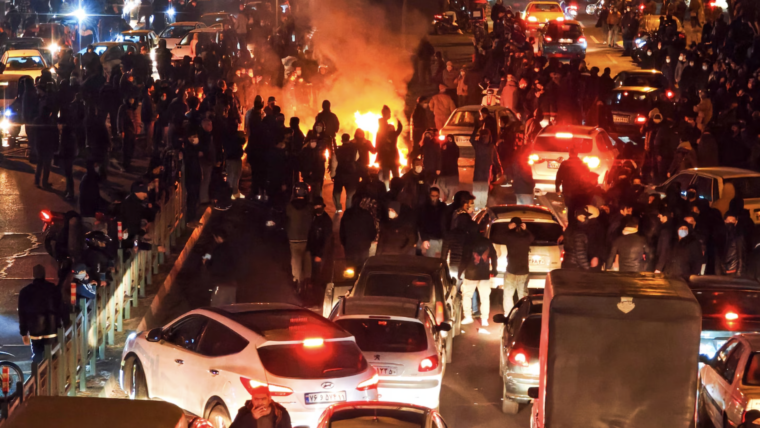
The recent protest movement in Iran has gathered unprecedented momentum amid a deepening economic and political deadlock. The situation has deteriorated to such an extent that even Supreme Leader Ali Khamenei publicly acknowledged the gravity of the crisis. In early January 2026, speaking through state media, he declared, “We talk to protesters, but there is no use in talking to rioters.” This carefully drawn distinction between “protesters” and “rioters” is politically revealing. It signals both an attempt to open limited space for negotiation and a simultaneous effort to legitimise intensified repression, reflecting a regime struggling to contain a crisis that increasingly challenges the foundations of its authority.
Since 2009, successive waves of protest have expressed a growing rejection of a political and economic order characterised by inequality, repression, and systematic exclusion. Yet the current mobilisation differs both qualitatively and quantitatively from previous cycles of unrest. It is characterised by broader coalitions, deeper cross-class alliances, and a more explicit break with the ideological and institutional foundations of the Islamic Republic. Notably, discontent has extended beyond students and urban middle classes to include segments of the working class and the traditional bazaar, historically one of the most important social pillars of the clerical establishment, which provided crucial financial and political support during the 1979 Revolution. The erosion of this alliance highlights the extent to which the regime’s traditional social coalitions are fracturing.
While immediate economic hardship has acted as a key trigger, driven by persistently high inflation, reported at over 40 per cent in early January 2026, the rapid depreciation of the national currency, and declining living standards, the protests cannot be understood as merely economic in nature. Rather, they are embedded in a wider political crisis that has progressively entangled the Islamic Republic. Years of domestic mismanagement, structural corruption, and the hollowing out of state institutions, combined with intensified Western pressure, particularly US-led sanctions, have produced a multidimensional impasse. Increasingly, ordinary Iranians experience their lives as constrained by four interlocking and destabilising forces: an unaccountable political system, a stagnant and sanction-ridden economy, pervasive social repression, and escalating regional and international tensions, none of which offers a credible or secure vision for the future.
Factor I: The Crisis of Authority
The Islamic Republic is increasingly paralysed: unable to reform its failing economic and political structures, and incapable of articulating a credible path forward. Public legitimacy is visibly eroding as protest movements move beyond material grievances to directly challenge the ideological foundations of the state. This has produced a crisis of authority in which the regime can neither govern effectively nor command belief.
Institutions that once promised justice, equality, and representation have become mechanisms through which the state and ruling elites protect and entrench emerging oligarchic interests. The judiciary and parliament mainly support elite control and suppress dissent. Real power lies with unelected groups, especially in security organisations, religious institutions, and economic networks linked to the state, which operate mostly out of public view.
Over the last decade, wealth has become increasingly concentrated among a small group closely tied to the state, military, and semi-private organisations, while the living standards of most people have declined. The top 10 per cent now own more than half of the country’s wealth. Over one-third of the population lives at or near the poverty line, and more than half face economic uncertainty. Since 2018, basic food prices have increased several times, but real wages have not kept up with inflation. This has created a clear divide between those who enjoy luxury and those who suffer from food insecurity, rising homelessness, and unstable living conditions.
Since the “Women, Life, Freedom” movement of 2022, and amid the growing threat of intervention by the US and Israel, particularly following the twelve days of war, the state has pursued limited social easing alongside renewed appeals to nationalism, most notably through the invocation of external threats. These measures, however, have failed to arrest the erosion of legitimacy or to appease ordinary Iranians.
Factor II: Opposition
Despite widespread discontent and repeated waves of protest, there remains no socially consolidated alternative capable of transforming street mobilisation into organised political power. Opposition forces are fragmented, weakly institutionalised, and often socially and geographically distant from everyday life inside Iran. Reformist currents within the system ultimately failed to bring about meaningful political or economic change. Over time, they came to embody managed adjustment rather than genuine transformation and steadily lost credibility among their own social base.
The 2009 Green Movement exposed the depth of popular dissatisfaction, mobilising millions around the slogan “Where is my vote?” and posing the most serious challenge to the system since the early revolutionary period. Yet its support remained largely concentrated among sections of the urban middle class. It avoided confronting deeper structures of power and failed to build durable links with workers and the urban poor. When repression intensified, its leadership was rapidly neutralised, leaving behind a legacy of disillusionment among Iranians who no longer trusted them.
Much of what now presents itself as opposition operates from abroad. Groups such as the Mojahedin-e Khalq (MEK) and figures like Reza Pahlavi have openly aligned themselves with Western governments and Israel. Although they enjoy Western platforms, funding, and media visibility, they lack broad legitimacy inside Iran and are widely viewed with scepticism or hostility. The collaboration between the MEK (People’s Mujahedin of Iran) and Saddam Hussein during the Iran-Iraq War from 1980 to 1988 severely tarnished the MEK’s reputation. For many Iranians, Reza Pahlavi is closely associated with the authoritarian legacy and social inequalities of the Pahlavi era (1925–1979). Neither the MEK nor Pahlavi has presented a credible vision rooted in social justice, democratic participation, and national independence. Their social foundations are weak, and their political influence on the ground remains limited.
Factor 3: Global Powers
Iran’s modern history has been repeatedly shaped by great-power intervention. From the late nineteenth century, Britain played a decisive role in restructuring Iran’s political order, a role increasingly assumed by the US after 1945. Britain helped bring Reza Shah to power in the 1920s and later joined the US in the 1953 coup that overthrew Prime Minister Mohammad Mossadegh. Anti-imperialism, therefore, became a central pillar of the 1979 Revolution. Yet external involvement did not end with the fall of the monarchy; it has continued in new forms, driven by Iran’s enduring strategic significance within global energy markets and regional power struggles.
The constant presence of regional and Western, particularly US, power remains a defining constraint. These actors operate within imperialist logics that treat Iranian instability less as a democratic concern than as a strategic opportunity serving their own geopolitical and economic interests. Sanctions, military pressure, covert operations, and financial exclusion are not temporary measures, but long-term instruments through which powerful states discipline peripheral and semi-peripheral societies.
Contemporary imperialism, however, no longer relies primarily on diplomacy or proxy alliances. As recent US actions, from Venezuela to the wider Middle East, demonstrate, it is increasingly characterised by overt coercion and the erosion of international legal norms.
Factor 4: Legitimacy and the Nation-state
Iran has entered a moment in which meaningful political choice is sharply constrained. Ordinary Iranians confront an unresponsive ruling system, a weak and fragmented opposition, and an international environment driven by geopolitical rivalry. This deadlock is further intensified by widespread fears of “Libyisation” and “Syriatisation”: the perception that state collapse or foreign intervention would not deliver freedom, but instead produce prolonged instability, internal conflict, and social disintegration.
Iran’s modern nation-state has been shaped through the Qajar, Pahlavi, and post-revolutionary periods, and is once again in deep crisis. Protests may not immediately overturn the system, but they continue to place its authority under sustained pressure to either open the political order, permit a genuinely democratic electoral process, and dismantle exclusionary institutions such as Shoray-e Negahban (the Guardian Council), which has long functioned to restrict political participation by filtering candidates for the presidency and parliament. It remains to be seen whether the Islamic Republic will respond to these demands in the coming weeks.
Conclusion
Across Iranian society, workers, women, and young people are experiencing shared hardship, exclusion, and repression. AS the struggle unfolds within a hostile international environment, in which Israel and Western powers continue to pose serious political, economic, and military threats to the country’s sovereignty and social stability. These common conditions, internal repression combined with external pressure, are quietly laying the foundations for a new kind of politics, one rooted in dignity, social justice, and democratic participation rather than elite domination or foreign control.
Solidarity with struggles against poverty, unemployment, discrimination, and repression is essential. Yet this struggle is not about returning to the past, nor about replacing one form of authoritarianism with another, nor about opening the door to foreign intervention. Durable change will not emerge from elite bargains or external power centres. It can only grow from the organised action, political consciousness, and leadership of ordinary people, which are only beginning to take shape. In this sense, the current protest wave, while signalling a deepening crisis of the Islamic Republic, also marks the opening of a new moment: the tentative formation of a new social and political force.